Scope the load first
An AC pad and a shop floor are different problems. We ask what sits on it, what drives across it, and what might in ten years, then set the thickness and the steel from those answers rather than pouring one slab for everything.
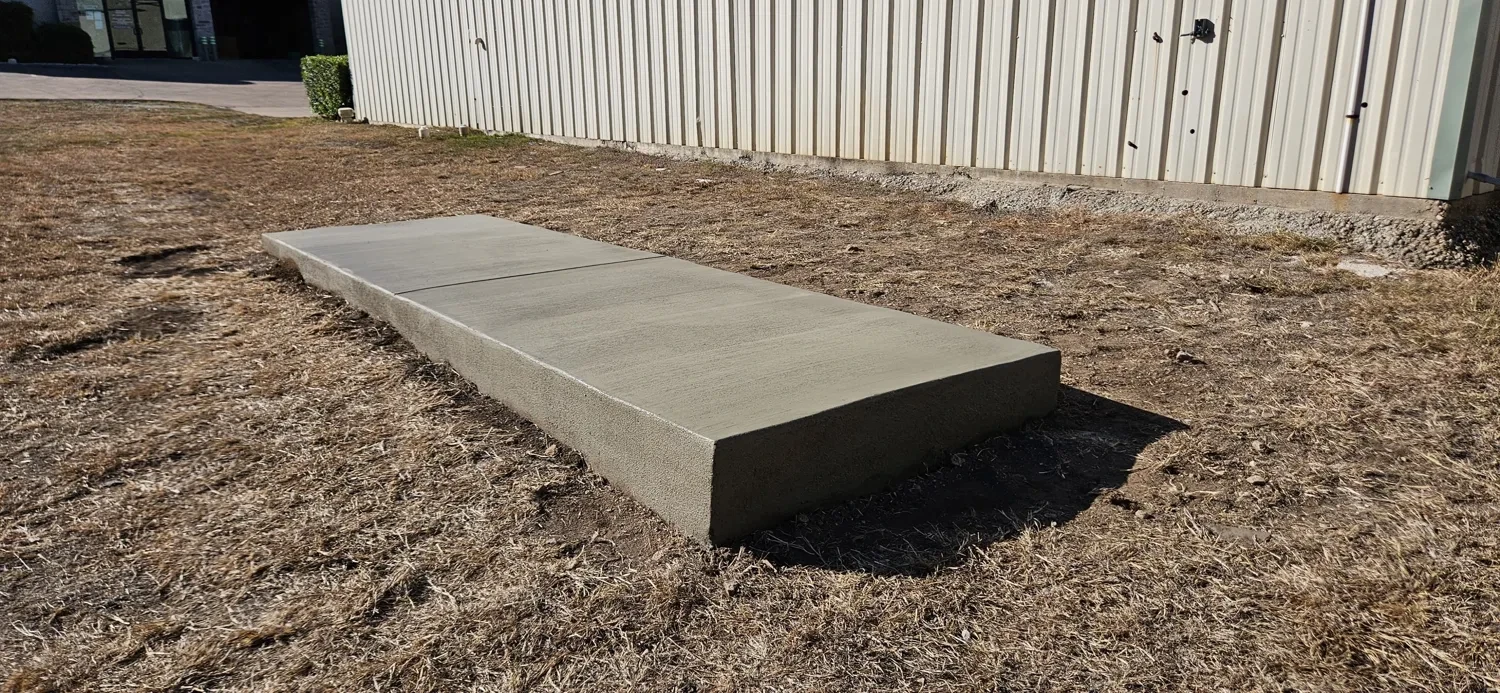
A lot of the failed slabs we see around Lubbock were poured straight onto grade decades ago, no base, no steel, just concrete on expansive clay, and the clay won. We pour shed, shop, AC, and RV slabs the other way: sized for the load, set on a compacted caliche base, and mixed to take the freeze-thaw.
Credibility comes from how it's built, not from promises. Here's the order of operations on every concrete pads & slabs job.
An AC pad and a shop floor are different problems. We ask what sits on it, what drives across it, and what might in ten years, then set the thickness and the steel from those answers rather than pouring one slab for everything.
We dig to plan depth, seat on or key into the caliche, moisture-condition the clay, and compact a crushed-caliche base. Skip this and you end up with the tilted shed pads that dot the South Plains, lifted off level by ground nobody prepared.
Lubbock is flat, so a pad has to be set on purpose or water gathers against it. We form so the finished slab sheds toward the yard or a swale and away from any structure, with elevations checked twice before a single yard of concrete is ordered.
Steel on chairs at mid-slab where it does its work, sized up to a rebar grid for heavy loads and dropped to mesh only where the load and the soil genuinely allow. The mix is air-entrained so a pad living outdoors takes the winter freeze-thaw without scaling.
Trowel finish for shop floors and anything living under a roof, broom for open-air pads, a vapor barrier under a slab that will carry a building or heated space so ground damp does not wick up, and anchor bolts or blockouts wherever the structure above needs them.
Most contractors vanish after the deposit. We pick up the phone, show up when we say, and stand behind the work after the truck leaves. The follow-through is the difference.
A foreman we know runs your job and a vetted crew does the work, managed by Lucky's, one company accountable from the first call to the final walkthrough.
COI and lien waivers on file before we break ground. The documentation that lets commercial clients pay and gives homeowners peace of mind.
Prepped subgrade, reinforced and mixed to spec for the job, and proper curing. We build credibility through the process, not promises. On concrete pads & slabs, that starts with scope the load first.

Pads and slabs on the South Plains generally start around $7 to $13 a square foot, moving with thickness, reinforcement, and how much caliche the excavation runs into. We price from a site visit, not a phone call, since the excavation and base work vary too much lot to lot to guess responsibly.
Four inches handles most sheds and light equipment; RV and vehicle pads run thicker with heavier steel, and a shop floor depends on what rolls or parks on it. Tell us the real use and we spec to it instead of pouring a single default for everyone.
Yes. Both are heavy and land their weight on a few points, so we build up the thickness and the rebar. A hot tub especially wants a true, settled base that will not lean as the clay works, so the groundwork carries as much of the job as the slab itself does.
The slab itself usually does not trigger one, but the structure going on it can, depending on its size and placement, and the rule differs between the City of Lubbock and the smaller towns around it like Wolfforth and Shallowater. We flag what applies during the estimate so nothing surprises you mid-project.
Almost always the same story: poured on unprepared clay, no reinforcement, and years of shrink-swell working underneath, sometimes with winter scaling on top. The fix is not more concrete over it; it is a tear-out and a base done right the second time.
Yes. We drill and dowel into the existing edge so the old and new pours act as one, match the elevations, and set an isolation or control joint at the seam. What we will not do is set a fresh slab up against the old one and hope the clay leaves it alone.
You'll hear back from a real person, usually the same day. No call center, no runaround, no chasing us down.
Booking up fast this season. Or call (806) 404-0876